
What is your metabolism?
Let’s start off strong - your metabolism isn’t ‘broken’, because it’s not something that can break.
Like all processes in your body, your metabolism is influenced by an array of variables that can cause it to slow down or speed up, but there’s more to it than that.
Often we get fed the belief that your metabolism is something you need to fix. It perpetuates this idea that it’s something you have no influence over, but in reality, it is something you can influence when you address the right variables.
What actually is your metabolism?
Metabolism is the total amount of energy your body uses to keep you alive and moving.
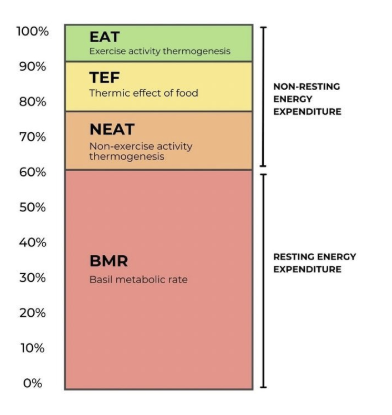
There’s different sub-categories that make up your total daily energy expenditure (TDEE).
BMR (Basal Metabolic Rate) – energy to exist.
This is influenced by:
Height
Weight
Age
Sex
Sleep
Energy availability
Hydration
Body composition (more muscle mass = larger energy expenditure)
Nutrient deficiencies
This makes up the largest amount of energy expenditure (50-70%) in sedentary populations.
NEAT (Non-Exercise Activity Thermogenesis) – steps, fidgeting, daily movement.
This is influenced by:
Fidgeting
Daily steps
Hours awake
Energy availability (up to 60% fluctuation between individuals).
NEAT covers all the things you do in a day that requires heat energy outside of purposeful exercise.
This category also has one of the largest variations between individuals, with it contributing between 15-50% of energy expenditure depending on things like the job you do (e.g. - someone working a physically demanding job where they’re on the move will have a higher NEAT contribution than someone who works a more sedentary office job), or how far you walk and move around in a day.
EAT (Exercise Activity Thermogenesis) – training sessions (aka, purposeful exercise).
This is influenced by:
Height
Weight (LBM)
Age
Duration, type, and intensity of exercise
This generally contributes 15-30% of your energy expenditure depending on how physically active you are.
Someone training 5-6 days a week, multiple times a day, will have greater energy expenditure than someone who trains 1-2 x per week for less time & intensity.
TEF (Thermic Effect of Food) – energy used to digest food.
This is influenced by:
Meal composition
Protein and fibre content of food
Age
Exercise
This generally contributes the smallest amount (8-15%) to your TDEE.
If you’re short, female, older, have less muscle mass, restrict your energy intake frequently, don’t move or train frequently, you’re likely to expend less energy, and therefore, have a ‘slower’ metabolism.
The further away you get from this description, the more energy you’re likely to expend and the ‘faster’ your metabolism will be.
In reality, your metabolism isn’t ‘slow’ or ‘fast’, it’s just responding to the conditions present.
Why Does Your Metabolism Change?
Your body loves to stay the same, so when you try to achieve a change in body weight (weight loss or weight gain), your body tries to adapt to either use less or more energy.
If you have consistently more energy than your body needs coming in (a surplus) → your body tries to adapt and use more of the energy up.
If you consistently have less energy than your body needs coming in (a deficit) → your body tries to adapt and use less energy.
This is a process called ‘adaptive thermogenesis’.
This basically refers to the decrease or increase in energy expenditure beyond what is predicted by changes in body weight and composition during caloric restriction or surplus, acting as a metabolic defence against weight loss or weight gain.
This process involves reduced resting metabolism and lowered activity-based energy expenditure, which can make sustained weight loss or weight gain difficult and promote weight regain in a deficit, or weight loss in a surplus.
We tend to see greater changes in your metabolism when dieting because your body perceives this as a more immediate threat to survival.
Less energy coming in → less energy available for vital bodily processes → more of an immediate threat, compared to excess energy intake.
The Dieting Reality.
Severe deficits or longer deficits tend to have a greater effect on adaptive thermogenesis, and we tend to see greater rates of re-gain post dieting.
It’s worth noting that this isn’t the case for every single person. Those that monitored their energy intake, body weight, and maintained high physical activity tended to be more successful in maintaining long-term changed body weight.
The same can occur for weight gain - some individuals are more predisposed to greater changes in adaptive thermogenesis when trying to gain weight, instead of losing it.
Whilst this makes up a smaller part of the population, it can still make gaining body weight challenging.
Why does this happen?
Alongside adaptive thermogenesis, your body has a series of mechanisms designed to oppose the maintenance of a reduced body weight.
This involves regulation of energy intake and expenditure, regulated by signals from your adipose (fat), gastrointestinal, and endocrine tissues, and integrated by the liver and central nervous system (CNS).
What I’m trying to get at here, is - your metabolism is influenced by many variables, but without the conscious alteration and maintenance of energy intake and expenditure, maintaining body weight changes long-term can be challenging.
This is why, when altering your body weight, looking at the changes you’re making to your diet and physical activity as a lifestyle change, rather than a temporary diet, is important.
Can You ‘Speed Up’ Your Metabolism?
In short, yes.
But if we think about all the things I’ve just mentioned - changes to your metabolism occur as a result of changes in the body's environment and conditions, so those are the things you need to look at.
No tea or ‘detox’ is going to be the thing that finally speeds it up.
Ways to increase energy expenditure:
Build muscle over time
Increase NEAT (e.g. - increasing daily steps)
Eat enough to fuel training
Stop chronic aggressive dieting
Prioritise an adequate amount + quality of sleep
Periodise nutrition with planned diet, maintenance, and surplus phases.
There are some nutrients that have a temporary impact on metabolism when consumed too.
Caffeine can temporarily increase metabolism (energy expenditure) due to its stimulant effects.
The dose of caffeine can affect the effect it has with doses over 10mg of caffeine associated with a more long-lasting effect.
It can achieve this by promoting the stimulation of the intermediary metabolism and present many effects in different tissues such as the CNS, skeletal muscle, cardiovascular, renal, and pulmonary tissue through the effect related to critical enzymes to metabolism.
Nicotine can also affect metabolism by acting as a potent stimulant and appetite suppressant, increasing the resting metabolic rate by approximately 10% and promoting fat breakdown (lipolysis) - aka, it can cause an increase in energy expenditure and decrease in energy intake.
It activates the sympathetic nervous system to increase energy expenditure and can cause weight loss, but it is associated with increased insulin resistance and central obesity.
Practical Takeaways.
If you’re wanting to lose or gain weight, approaching it in a planned and strategic way can make achieving and sustaining body weight changes more realistic.
Track steps for a week.
Focus on building muscle over the next year.
Stop crash dieting with severe deficits or for long periods of time.
Look at weekly averages in body weight, not daily scale spikes.
Prioritise protein + resistance training.
Focusing on spending most of your time eating at maintenance (and getting really good at maintaining a steady body weight), focusing on building muscle, and eating a high quality diet with abundant amounts of protein and fibre will have the most beneficial effect.
